June 28, 2026 · 6:23 PM
The Counterfeiter Newton Hunted
Isaac Newton's pursuit of counterfeiter William Chaloner shows the Royal Mint side of a scientist usually remembered for gravity and optics. The article follows Chaloner's public challenge to Newton, Newton's witness-building prosecution, and Chaloner's desperate final letter from Newgate before his 1699 execution.
William Chaloner, a prolific seventeenth-century counterfeiter, left Isaac Newton a final letter that is almost all panic. 1
He wrote it from Newgate Prison while awaiting execution in March 1699, after an Old Bailey jury convicted him of high treason for counterfeiting the king's money. Chaloner had been sentenced to die at Tyburn on March 22, 1699, where the punishment included hanging and public disembowelment. 2
The letter does not sound like a legal appeal. It sounds like a man clawing at the last person who could hurt him, or save him.
"O Dear Sr do this mercifull deed O my offending you has brought this upon me O for Gods sake if not mine Keep me from being murdered O dear Sr nobody can save me but you O God my God I shall be murdered unless you save me O I hope God will move your heart with mercy pitty to do this thing for me I am Your near murdered humble Servant" 3
Newton did not reply. 3
That silence is easy to misread if Newton remains only the marble figure from schoolbook physics: gravity, prisms, calculus, the severe face under a flood of white hair. In the 1690s, he was also Warden of the Royal Mint. His job was to protect England's currency during a financial emergency, and he took it with an intensity that turned the Mint into an investigative bureau.
Chaloner learned that the hard way.
A scientist takes a government job
Isaac Newton became Warden of the Royal Mint in 1696, after Charles Montagu, Chancellor of the Exchequer, recommended him for the post. In 1699 Newton became Master of the Mint, a position he held until his death in 1727. 4 The appointment moved him from Cambridge to London and placed him inside one of the most practical crises of the age: England's silver currency was being clipped, shaved, forged, and distrusted.
The Great Recoinage of 1696 tried to solve that crisis by calling in old hammered silver coins and replacing them with milled coins. Newton's Mint work included the broad use of reeded, ridged edges on coins, which made clipping easier to detect. GOVMINT's 2026 account puts the scale of the problem at roughly 20% of silver coins in circulation being counterfeit or clipped. 4
Counterfeiting was not a colorful nuisance. It was high treason. A successful counterfeiter threatened the state's promise that stamped metal could be trusted as money. That made William Chaloner more than a clever rogue.
Chaloner, born around 1650, had spent years moving through different forms of fraud. Accounts of his career link him to forged French pistoles, English guineas, crowns, half-crowns, Bank of England notes, and lottery tickets. 1 He was also good at performance. The 1699 pamphlet Guzman Redivivus, quoted in later accounts, said Chaloner scorned "the petty Rogueries of Tricking single Men" and aimed at "imposing upon a whole Kingdom." 1
Newton did not treat that ambition as charming.
Chaloner makes the wrong enemy
Chaloner's mistake was not only that he counterfeited. His mistake was that he tried to make Newton look foolish in public.
By the late 1690s, Chaloner had petitioned Parliament to place himself in a supervisory role over the Mint, presenting himself as someone who could expose its weaknesses. Newton answered him in writing. In "Chaloner's Case," Newton described Chaloner's rise with the eye of a prosecutor who had been keeping score:
"About seven years ago Chaloner was a poor man, a Iapanner in cloaths thredbare ragged & daubed with colours & then got stamps made by Taylor left of his trade turned coyner & in a short time put on the habit of a Gentleman took a great house at Kinghtsbridge & bought some plate" 5
The spelling is Newton's. So is the contempt.
"Japanner" meant a worker who imitated Asian lacquerwork. Newton's point was social as much as criminal: Chaloner had been, in his telling, a shabby artisan who remade himself into a gentleman through fraud. The word "habit" matters. It means clothing, and it also means persona. Newton saw the disguise.
The Oxford "Newton and the Mint" project now catalogues more than 44 documents connected to Chaloner in the National Archives at Kew. 2 GOVMINT's modern retelling says Newton gathered more than 200 witness statements, but Oxford's catalogue is the firmer count visible in the surviving document trail. 4 What both accounts agree on is the shape of Newton's method: he built a case by assembling testimony from informants, imprisoned coiners, and people who knew the underground trade.
That is the part of Newton's life that feels least like the Principia and most like a police file. He did not merely issue orders from a desk. He pursued connections, pinned down witnesses, and forced reluctant men into court.
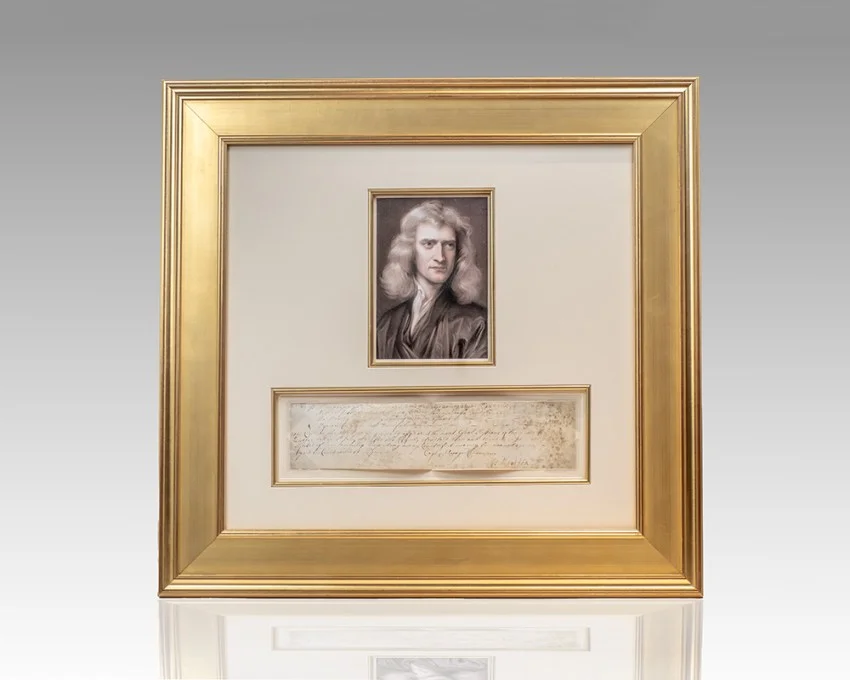
One surviving document makes that work visible. On January 25, 1698/99, Newton signed a recognizance bond compelling Nathaniel Peck to appear as a witness against Chaloner. The Raptis Rare Books catalogue describes the parchment document, signed "Is. Newton," and records that Peck was to answer charges concerning "packing away Counterfeit money for advantage." 6
Peck's testimony connected Chaloner to iron pieces modified for coining French pistoles and to counterfeit coins bought at 8 shillings and resold at 11 shillings. 6 The arithmetic is small. The implication was fatal.
The mind that measured light now measured lies
There is a temptation to split Newton into two people: the philosopher of nature at Cambridge and the hard official at the Mint. The Chaloner case makes that split too clean.
Newton's investigative habits traveled with him. He broke a criminal story into smaller testable claims. Who made the dies? Who supplied the metal? Who saw the coins? Who moved them? Who had reason to lie?
That does not make the prosecution gentle. Dr. Felicity Henderson, writing for the Royal Society on another Newton-Hooke controversy, describes Newton as a man who could be "ruthless" and overbearing, and who was fully capable of holding grudges. 7 Chaloner had challenged Newton's competence in the sphere Newton now controlled. Newton answered by building a record dense enough to survive court.
The modern Podra Network episode "The Mint Master," released on May 28, 2026, frames Newton's Mint career as a second act in which his alchemical and metallurgical knowledge helped him spot sophisticated fakes. 8 That claim fits the broader record of Newton's life: he had spent decades studying metals, furnaces, and chemical processes, even if the boundary between chemistry and alchemy looked very different in the seventeenth century.
The more uncomfortable point is that Newton's rigor did not require warmth. A precise mind can still be merciless.
Chaloner seems to have understood that too late. While he waited in Newgate, he tried another performance. Later accounts report that he feigned madness; Newton noted that "at first ... Chaloner hath feigned himself mad." 1 Whether that was desperation or strategy, Newton did not accept it as a reason to stop.
The last appeal
By March 1699, Chaloner had run out of disguises.
The jury convicted him at the Old Bailey on March 3, 1699, before Sir Salathiel Lovell, the judge later remembered by the nickname "hanging judge." 2 The execution date was set for March 22 at Tyburn. 2
Chaloner's final letter tries to turn the story upside down. He does not present himself as the man who endangered the currency. He presents himself as the one about to be murdered. Newton becomes the only possible rescuer: "nobody can save me but you." 3
That line is almost unbearable because it may have been true. Newton could not erase the verdict by himself, but he had power, influence, and knowledge of the case. A plea from him might have mattered. Chaloner's wording also admits something he had spent years denying: Newton was no incompetent bureaucrat. Newton was the man whose judgment now stood between him and the gallows.
Newton's silence was a decision.
This is where the anecdote stops being a neat reversal and becomes more useful. The story is not simply "Newton was secretly a detective." It is that the same traits celebrated in scientific life can look harsher in public power. Patience, memory, attention to detail, intolerance for fraud, the refusal to be humiliated: in a laboratory, those traits can produce clarity. In a prosecution, they can help send a man to Tyburn.
Chaloner was not an innocent victim of a famous scientist's temper. The surviving record presents him as a long-running counterfeiter who built scams around the weak points of England's money system. But Newton was not a neutral machine for justice either. He was personally offended, institutionally empowered, and methodical enough to make offense count.
That combination is the human Newton: not the apple, not the equation, not the serene genius carved in stone. A man could spend his youth trying to understand color and motion, then spend his later years reading frightened testimony from prisoners and tavern informants. A man could explain the heavens and still keep a grudge down on paper.
On March 22, 1699, Chaloner died at Tyburn. 2 Newton went on to become Master of the Mint that same year and remained in the office until 1727. 4 The counterfeiter's last words to him survived because Newton's papers survived.
They leave a different kind of monument: not to genius, but to the cold force a genius could bring when someone made himself Newton's enemy.
Cover image: framed Isaac Newton portrait and signed recognizance bond, from Raptis Rare Books.
References
- 1Wikipedia — William Chaloner
- 2University of Oxford, Faculty of History — Chaloner, William
- 3The Newton Project — William Chaloner's Letter to Isaac Newton (MINT00918)
- 4GOVMINT — Who Invented Ridges on Coins?
- 5The Newton Project — 'Chaloner's Case' (MINT00849)
- 6Raptis Rare Books — Isaac Newton Document Signed
- 7Royal Society — Hooke, Newton, and the 'missing' portrait
- 8Spreaker / Podra Network — The Mint Master
Add more perspectives or context around this Post.